The Shift from DevOps to Platform Engineering: Why IDPs Are the Future of Software Delivery
· Sourabh G Kulkarni
As software systems grow increasingly complex, the 'you build it, you run it' DevOps model is creating developer cognitive overload. Discover why the industry is shifting to Platform Engineering and building Internal Developer Platforms (IDPs) with paved Golden Paths to prioritize Developer Experience (DevEx).
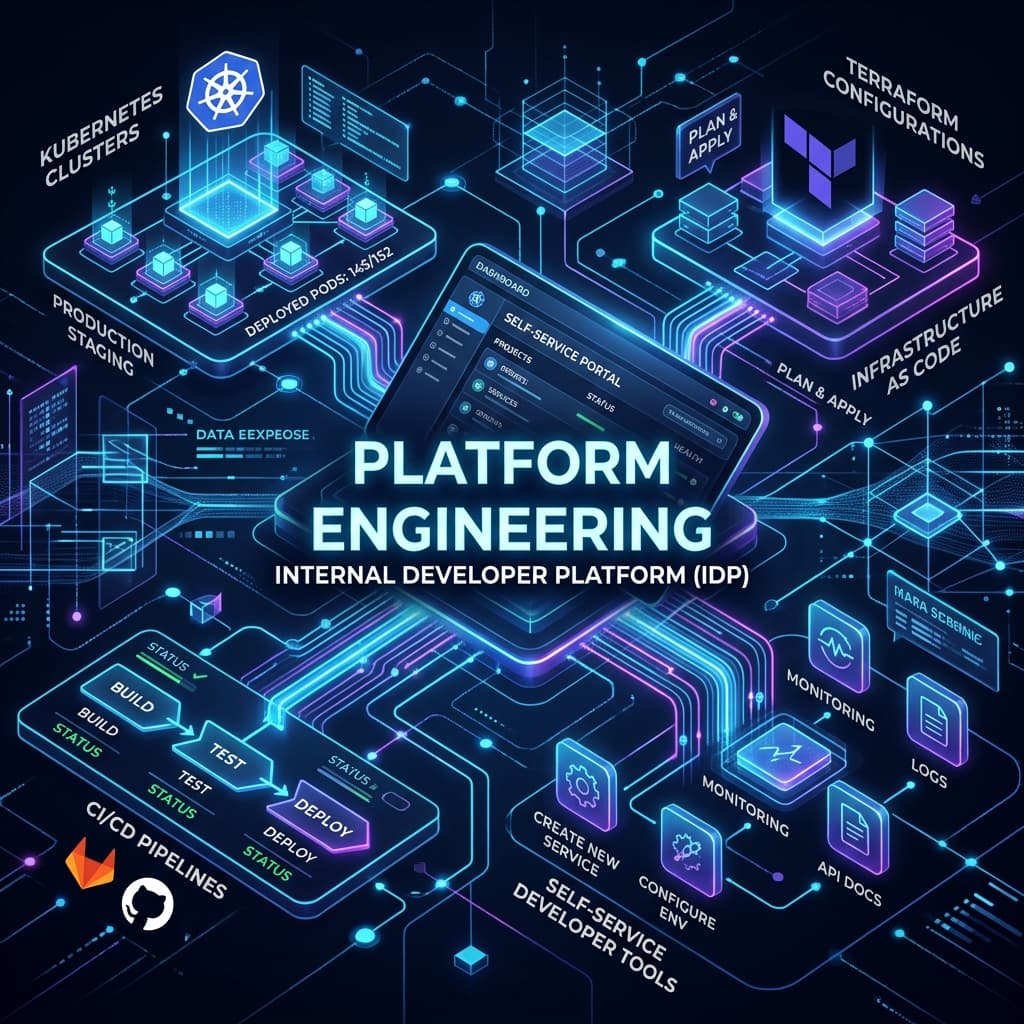
For the last decade, the tech industry has operated under a simple, powerful promise: DevOps. By breaking down the silos between software developers and system operations, DevOps promised faster release cycles, lower failure rates, and shared accountability. The battle cry was clear: "You build it, you run it."
But as we navigate the complexities of modern cloud-native systems, that battle cry is starting to sound more like a burden.
Today, a product developer is not just responsible for writing clean business logic. They are expected to write Dockerfiles, configure Kubernetes manifests, orchestrate multi-environment Terraform scripts, set up continuous integration (CI) and continuous deployment (CD) pipelines, debug Prometheus alerting configurations, and monitor cloud spend.
This is not efficiency—it is cognitive overload. The sheer complexity of modern infrastructure is slowing product delivery down, leading the industry to a critical turning point: the emergence of Platform Engineering and Internal Developer Platforms (IDPs).
The Root Problem: Developer Cognitive Overload
In the early days of DevOps, containerizing an application and deploying it via a basic Jenkins pipeline felt liberating. But as environments scaled, the tool landscape exploded. According to recent developer surveys, engineers now spend up to 30% of their weekly capacity managing deployments, wrestling with Kubernetes clusters, and waiting on infrastructure tickets.
When we ask developers to manage the entire stack, we force them to become jack-of-all-trades and masters of none. Instead of building business value, they spend hours troubleshooting networking routing rules or fixing minor syntax errors in massive Yaml configuration files.
This friction has a name: poor Developer Experience (DevEx). If the friction is high, velocity drops, burnout spikes, and security becomes harder to enforce.
Enter Platform Engineering: "Platform as a Product"
Platform Engineering is the discipline of designing and building toolchains and workflows that enable self-service capabilities for software engineering teams.
Rather than telling developers to "go figure out AWS/Kubernetes," Platform Engineering teams build an Internal Developer Platform (IDP).
An IDP is a curated set of tools, services, and technologies that platform teams assemble to create smooth, automated developer workflows. The philosophy behind this is simple but transformative: Platform as a Product.
Under this model, the platform team treats developers as customers. They conduct user research, gather feedback, monitor usage analytics, and design the platform to solve actual developer bottlenecks, rather than chasing a checklist of the newest open-source tools.
The Core Concept: "Golden Paths" (or Paved Roads)
At the heart of any successful Internal Developer Platform is the concept of the Golden Path (originally popularized by Spotify).
A Golden Path is a pre-packaged, fully supported path for shipping software.
It provides product developers with automated, standard templates for creating, deploying, and operating services. For example, a developer wanting to spin up a new microservice doesn't start from scratch. Instead, they access a developer portal like Spotify’s Backstage, select a template, and with one click:
- A new git repository is initialized with a standard boiler-plate project structure.
- Desired infrastructure (e.g., an AWS S3 bucket and PostgreSQL database) is provisioned declaratively via Terraform or OpenTofu.
- Gated CI/CD pipelines (like GitHub Actions or GitLab CI) are pre-configured.
- GitOps triggers (such as ArgoCD) are hooked up to synchronize the repository with a staging Kubernetes cluster.
- Monitoring and observability alerts (Prometheus and Grafana) are pre-loaded.
graph LR
    A["Developer Portal (Backstage)"] --> B["Provisioning IaC (Terraform)"]
    A --> C["Gated CI/CD (GitHub Actions)"]
    A --> D["GitOps Sync (ArgoCD)"]
    B --> E["Cloud Resources (AWS/Azure)"]
    C --> F["Container Registry (Docker)"]
    D --> G["Kubernetes Cluster"]
    F --> G
The developer is free to deviate from the Golden Path if their application requires special configurations. However, by staying on the paved road, they get built-in safety, automated security compliance, and full support from the platform team. It lowers cognitive load while reinforcing security, auditability, and standardization by design.
Building the "Thinnest Viable Platform" (TVP)
One of the biggest mistakes platform teams make when embarking on this journey is trying to build a monolithic, all-encompassing portal from day one. They spend months architecting a massive Backstage integration before delivering any value.
The best practice in 2026 is to build the Thinnest Viable Platform (TVP).
Ask your development teams: “Where is the biggest friction in your daily workflow?”
- If the bottleneck is spinning up cloud databases, start by building an automated, self-service database provisioner.
- If it is waiting for QA environments, implement Ephemeral Environments (Environment-as-a-Service) that spin up automatically on every pull request and tear down on merge.
- If it is configuring deployment variables, build a shared secret-management pipeline.
Solve one bottleneck, gather feedback, stabilize the template, and then move to the next. Treat the platform as an evolving software product that grows alongside your organization's needs.
The Role of GitOps, FinOps, and AI in Modern IDPs
Modern platform engineering does not exist in isolation. It converges with several critical industry trends:
1. Declarative GitOps
An IDP should enforce declarative state management. By combining GitOps tooling (like ArgoCD) with Infrastructure-as-Code, the entire state of your application and environment is versioned, reviewed, and audited inside git.
2. Embedded FinOps
Cloud cost management cannot be a monthly cleanup chore. Modern IDPs integrate cost-observability tools (like Kubecost) directly into the developer dashboard, enabling developers to see the cost implications of their microservices in real-time, driving financial accountability.
3. Agentic AI & Autonomous Troubleshooting
The newest shift in Platform Engineering is the integration of autonomous AI Agents. When a CI/CD build fails or a Kubernetes pod enters a CrashLoopBackOff state, AI-driven diagnostics analyze logs and traces to suggest precise fixes or even trigger automated rollbacks, reducing Mean Time to Resolution (MTTR) dramatically.
Conclusion: Platform Engineering is the Maturation of DevOps
Platform Engineering is not replacing DevOps; it is the natural maturation of it. By applying product management principles to infrastructure, Platform Engineering shifts the responsibility of automation from individual product developers to a dedicated platform team.
The result? Developers focus on what they do best: writing code and delivering features. Operations teams focus on scaling the platform, enforcing security, and optimizing cloud architectures.
By building an Internal Developer Platform with paved Golden Paths, you don't just speed up delivery—you build a resilient engineering culture that scales without drowning in the ever-expanding ocean of cloud complexity.