The Evolution of Cloud Roles: From Sysadmin to DevOps, SRE, Platform Engineering, and FinOps
· Sourabh G Kulkarni
How infrastructure careers evolved over 25 years. A complete breakdown of Cloud Architects, DevOps Engineers, SREs, Platform Engineers, DevSecOps, and FinOps: what they do, why they exist, when to hire them, and how they collaborate.
Twenty years ago, enterprise IT had a straightforward job title for the person responsible for production: The System Administrator.
The sysadmin racked servers in noisy server rooms, ran blue Ethernet cables through raised floors, manually installed Debian or Red Hat from optical discs, configured Apache virtual hosts, and wrote cron jobs to dump MySQL databases onto backup magnetic tapes.
Today, that single job has fragmented into a specialized ecosystem of cloud roles:
- Cloud Solutions Architect
- DevOps Engineer
- Site Reliability Engineer (SRE)
- Platform Engineer
- DevSecOps / Cloud Security Engineer
- FinOps Practitioner
Job seekers find this alphabet soup confusing. Engineering leaders struggle with headcount allocation. And companies frequently hire for one title while actually needing the capabilities of another.
This guide provides a comprehensive, field-tested overview of how cloud operations evolved, what each role actually does, how they differ across key metrics and toolchains, and exactly when an organization should hire each one.
1. The 25-Year Timeline: How One Role Became Six
The fragmentation of operations was not driven by buzzwords. It was forced by an exponential explosion in system scale and cloud complexity.
┌────────────────────────────────────────────────────────────────────────┐
│                     The 25-Year Operations Timeline                    │
├────────────────┬───────────────────────────────────────────────────────┤
│ 1995–2005      │ **The Sysadmin Era:** Physical data centers, manual   │
│                │ racking, shell scripts, tickets, high silos.          │
├────────────────┼───────────────────────────────────────────────────────┤
│ 2006–2010      │ **The Cloud Awakening:** AWS launches S3 & EC2.      │
│                │ Hardware becomes software APIs. Puppet & Chef appear. │
├────────────────┼───────────────────────────────────────────────────────┤
│ 2009–2015      │ **The DevOps Revolution:** Breaking Dev/Ops silos.    │
│                │ Docker arrives (2013). CI/CD automation goes mainstream│
├────────────────┼───────────────────────────────────────────────────────┤
│ 2015–2020      │ **The SRE & Cloud-Native Boom:** Google SRE book.     │
│                │ Kubernetes becomes the distributed operating system.   │
├────────────────┼───────────────────────────────────────────────────────┤
│ 2020–Present   │ **The Specialization Era:** Developer cognitive load  │
│                │ forces Platform Engineering, FinOps, and DevSecOps.   │
└────────────────┴───────────────────────────────────────────────────────┘
When infrastructure became programmable APIs (AWS, Azure, GCP) and container schedulers (Kubernetes) abstracted servers away, no single human being could master enterprise cloud architecture, CI/CD pipelines, 99.99% high-availability mathematics, container security auditing, and multimillion-dollar cloud unit economics simultaneously.
Specialization became inevitable.
2. The Cloud Roles Breakdown: What, Why, How, and When
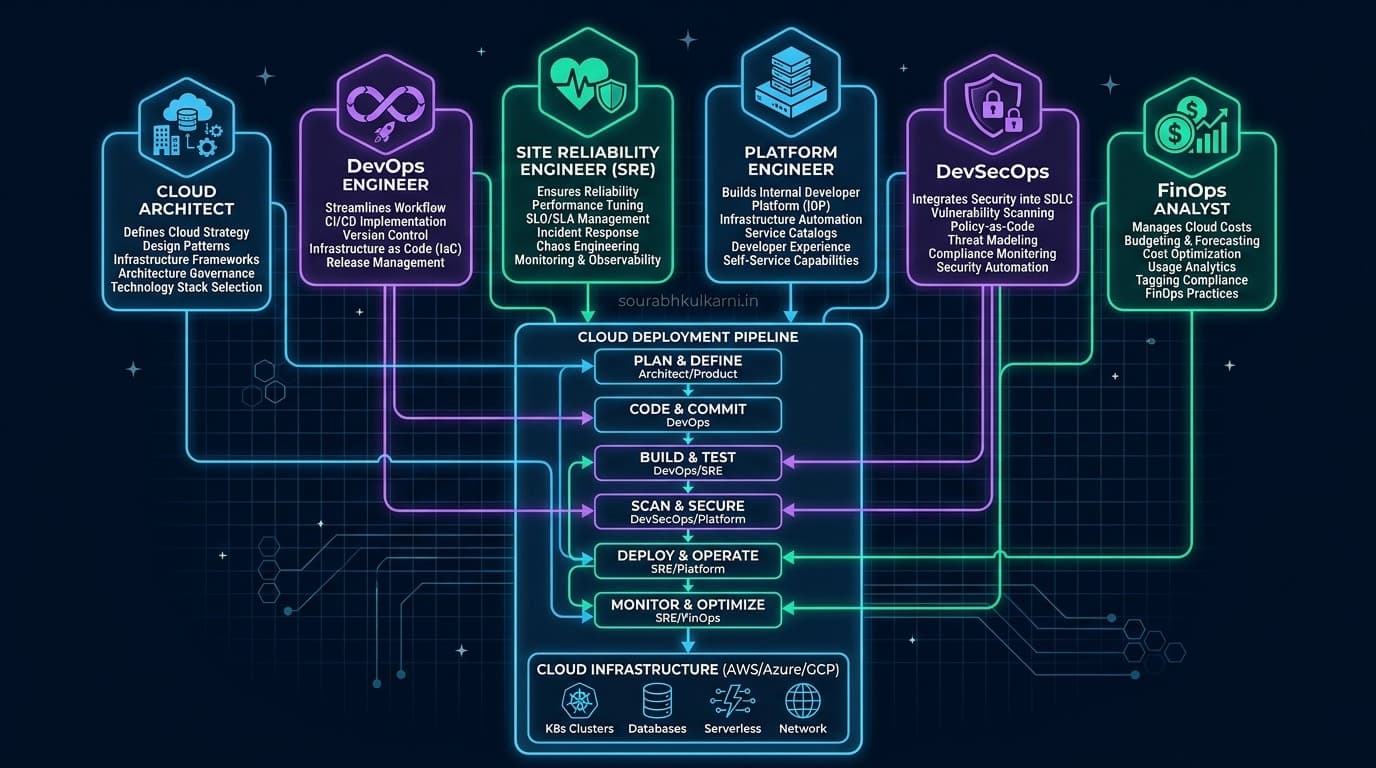
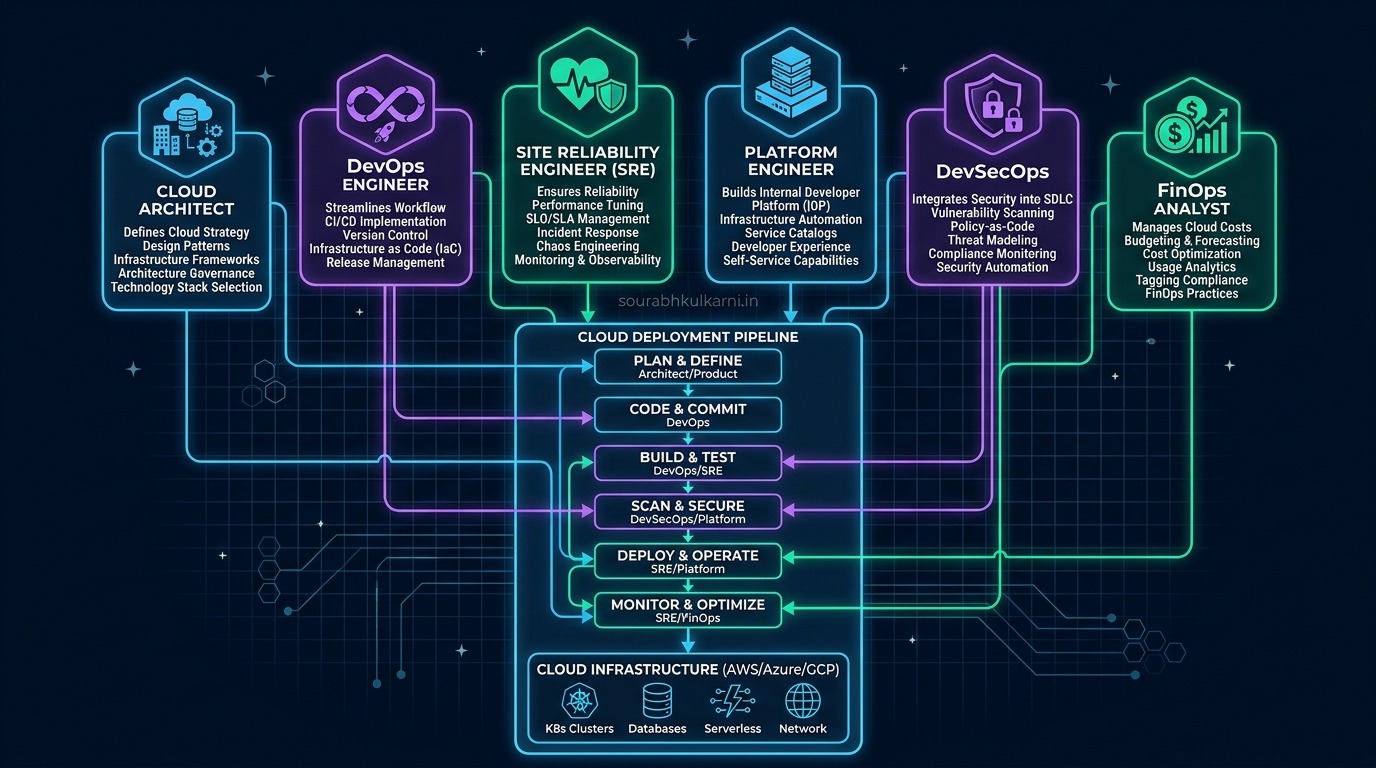 The Evolution of Cloud Roles Architecture
Figure 1: The six pillars of modern cloud operations and how they feed into unified deployment pipelines and cloud infrastructure.
Here is the concrete operational breakdown of the six modern cloud roles:
Role 1: Cloud Solutions Architect
The High-Level System Designer
- What They Do: The Cloud Architect designs the macro-level blueprints of an organization's digital infrastructure. They select the foundational cloud provider services, define multi-region disaster recovery models, design hybrid-cloud networking (DirectConnect / ExpressRoute / Transit Gateways), and ensure enterprise systems meet non-functional requirements (scalability, compliance, latency, cost).
- Core Toolchain: Architecture diagrams (Lucidchart, Draw.io), Cloud Architecture Frameworks (AWS Well-Architected, Azure Cloud Adoption Framework), Terraform / Bicep, IAM policies, and cloud cost calculators.
- Key Metrics: System availability, cost efficiency, architectural compliance, time-to-deliver new system blueprints.
- When to Hire: When transitioning from legacy data centers to the cloud, or when microservices complexity demands unified, cross-cutting architectural standards across multiple engineering teams.
Role 2: DevOps Engineer
The Delivery Pipeline & Velocity Champion
- What They Do: The DevOps Engineer focuses on speed and flow. Their mission is taking code from a developer's pull request to production as quickly, safely, and frictionlessly as possible. They build and optimize continuous integration and continuous deployment (CI/CD) pipelines, automate testing gates, containerize applications, and eliminate operational bottlenecks between software developers and production environments.
- Core Toolchain: GitHub Actions, GitLab CI, Jenkins, Docker, Helm, ArgoCD, Ansible, Bash, Python, Linux.
- Key Metrics: DORA Metrics — Deployment Frequency, Lead Time for Changes, Change Failure Rate, and Mean Time to Recovery (MTTR).
- When to Hire: Early in a company's growth (Series A / B) when developers are spending hours manually deploying code, suffering deployment failures, or lacking standardized automated testing.
Role 3: Site Reliability Engineer (SRE)
The Mathematical Reliability Guardian
- What They Do: Pioneered by Google, SREs apply software engineering to operations problems. SREs treat production reliability not as a subjective feeling, but as a mathematical contract governed by SLIs, SLOs, and Error Budgets. They automate incident triage, lead blameless postmortems, engineer self-healing systems, conduct chaos engineering experiments, and ensure mission-critical applications survive unexpected traffic surges and hardware outages.
- Core Toolchain: Prometheus, Grafana, OpenTelemetry, Datadog, PagerDuty, Go, Python, Kubernetes, Chaos Mesh.
- Key Metrics: SLO adherence, Error Budget burn rate, Mean Time to Detect (MTTD), Mean Time to Mitigate (MTTM), Percentage of time spent on automating toil (Google 50% rule).
- When to Hire: When your product reaches customer-critical scale where outages carry direct financial, legal, or reputational penalties (typically 20+ engineers or $5M+ ARR).
Role 4: Platform Engineer
The Internal Developer Platform (IDP) Product Builder
- What They Do: The Platform Engineer treats internal software developers as their customers. In response to the cognitive fatigue caused by Kubernetes and cloud complexity, platform teams build an Internal Developer Platform (IDP). They design opinionated, self-service Golden Paths that let product developers provision databases, spin up microservices, deploy to staging, and configure monitoring in minutes without touching raw cloud consoles or filing operational tickets.
- Core Toolchain: Backstage (Spotify), Kubernetes, Terraform, Crossplane, ArgoCD, Helm, Go, Port, Internal CLI tools.
- Key Metrics: Developer Experience (DevEx), Developer NPS, Time to First Production Commit for new hires, Self-service adoption rate, Lead time for infrastructure provisioning.
- When to Hire: When scaling past 50–100 engineers, where decentralized teams are reinventing their own pipelines and product developers spend 30%+ of their sprints wrestling with infrastructure.
Role 5: DevSecOps / Cloud Security Engineer
The Shift-Left Governance Architect
- What They Do: Historically, security was an external gate at the very end of the release cycle that said "No" right before a launch. DevSecOps embeds security directly into the developer workflow. They implement Static Application Security Testing (SAST), Dynamic Analysis (DAST), Software Bill of Materials (SBOM), container vulnerability scanning, secrets detection, and Cloud Security Posture Management (CSPM).
- Core Toolchain: Snyk, Trivy, SonarQube, Prisma Cloud, HashiCorp Vault, AWS GuardDuty, OPA / Gatekeeper, Kyverno.
- Key Metrics: Mean Time to Remediate vulnerabilities (MTTR), Number of critical CVEs deployed to production, Secrets leaked in Git, Compliance pass rates (SOC2, ISO 27001).
- When to Hire: When operating in regulated sectors (FinTech, HealthTech) or scaling toward SOC2/enterprise compliance audits.
Role 6: FinOps Practitioner / Cloud Financial Manager
The Cloud Unit Economics Strategist
- What They Do: Cloud computing transformed capital expenditure (CapEx) into unpredictable, variable operational expenditure (OpEx). If a developer leaves a 100-node GPU Kubernetes cluster running over a weekend, the company gets a $20,000 bill on Monday. FinOps bridges engineering, finance, and product to establish cloud financial accountability. They optimize Reserved Instances, Savings Plans, and spot instances, rightsize over-provisioned clusters, and establish unit economics (e.g., "How much does infrastructure cost per active user?").
- Core Toolchain: Kubecost, Vantage, CloudHealth, Infracost, AWS Cost Explorer, Azure Cost Management.
- Key Metrics: Cloud spend vs. budget, Percentage of wasted/idle compute, Spot/Savings Plan coverage ratio, Unit cost per customer transaction.
- When to Hire: When monthly cloud bills exceed $25,000–$50,000/month, where unmonitored waste begins eating into gross margins.
3. The Master Cloud Roles Comparison Matrix
| Dimension | Cloud Solutions Architect | DevOps Engineer | Site Reliability Engineer (SRE) | Platform Engineer | DevSecOps Engineer | FinOps Practitioner |
|---|---|---|---|---|---|---|
| Primary Mission | High-level system design & cloud strategy. | Continuous delivery pipelines & deployment flow. | System reliability, availability & uptime. | Self-service golden paths & developer experience. | Embedded security, vulnerability scanning & compliance. | Cloud cost visibility, efficiency & unit economics. |
| Primary Customer | Enterprise Leadership & Engineering Teams. | Product Development Teams. | End Users & Customers relying on service. | Internal Software Developers. | Security & Compliance Officers; Auditors. | CFO, Finance Team & Engineering Leaders. |
| Core North Star Metric | Architecture scalability & Well-Architected alignment. | DORA Metrics (Deployment speed & lead time). | SLO Adherence & Error Budget burn rate. | DevEx & Time-to-first-production-commit. | MTTR for Critical CVEs; Zero breaches. | Cloud Unit Cost & Waste reduction ratio. |
| Key Daily Artifacts | Architectural diagrams, RFCs, cloud blueprints. | CI/CD YAML files, Dockerfiles, release automation. | Observability dashboards, alert runbooks, postmortems. | Internal Developer Portals (Backstage), CLI tools, templates. | Security scanning policies, secret vaults, compliance reports. | Cost allocation tags, budget dashboards, rightsizing rules. |
| Dominant Skillset | Cloud networking, system design, vendor evaluation. | CI/CD engines, Linux, scripting, container orchestration. | Distributed systems debugging, coding (Go/Python), metrics. | Software engineering, API design, empathy for developer pain. | Cryptography, threat modeling, security compliance, IAM. | Data analytics, cloud billing APIs, financial modeling. |
4. The Organizational Maturity Curve: When to Hire Which Role
A common startup blunder is hiring a dedicated SRE or FinOps engineer when the company only has five developers.
Here is how mature organizations phase these roles as they grow:
┌────────────────────────────────────────────────────────────────────────┐
│                   Hiring Sequencing by Company Scale                   │
├─────────────────┬──────────────────────────────────────────────────────┤
│ 1–15 Engineers  │ **Generalists:** Full-stack developers using managed  │
│ (Seed / Early)  │ PaaS (Vercel, Render, AWS ECS). Zero dedicated ops.  │
├─────────────────┼──────────────────────────────────────────────────────┤
│ 15–50 Engineers │ **First DevOps Hire:** Centralizes CI/CD pipelines,  │
│ (Series A / B)  │ standardizes Docker, introduces Terraform.           │
├─────────────────┼──────────────────────────────────────────────────────┤
│ 50–150 Engineers│ **Introduce SRE & Cloud Architect:** Mission-critical │
│ (Series C / D)  │ uptime matters. Formalize SLOs, on-call rotations,   │
│                 │ and hire an Architect for multi-region scale.        │
├─────────────────┼──────────────────────────────────────────────────────┤
│ 150+ Engineers  │ **Platform Engineering, DevSecOps & FinOps:**       │
│ (Enterprise)    │ Build dedicated IDP to defeat developer cognitive    │
│                 │ load. FinOps reclaims cloud waste. Security shifts left.│
└─────────────────┴──────────────────────────────────────────────────────┘
5. How They Collaborate: The Modern Engineering Engine
In a high-performing enterprise, these roles do not operate in competing silos. They function as a coordinated delivery engine:
- The Cloud Architect designs the multi-account AWS/Azure topology and security boundary.
- The Platform Engineer encodes that architecture into self-service Backstage templates and automated Terraform modules.
- The DevSecOps Engineer embeds automated vulnerability scanners and IAM guardrails into the platform's golden path.
- The SRE establishes the monitoring baselines, alerts, and SLOs that automatically attach to any new service created by the platform.
- The FinOps Practitioner enforces cost allocation tags and cluster rightsizing policies transparently in the background.
- The DevOps Practitioner maintains the shared CI/CD runners and deployment pipelines that deliver the code.
- The Product Software Engineer simply writes business features, clicks "Create Service" on the internal developer platform, and ships to production safely in minutes.
The Engineering Conclusion
Cloud computing did not eliminate operations—it democratized it, digitized it into code, and elevated it into a critical business discipline.
Whether your official title is DevOps Engineer, SRE, Platform Engineer, or Cloud Architect, the underlying engineering mandate remains the same: managing systems complexity so software can deliver value reliably, securely, and sustainably at scale.
By understanding the distinct strengths of each role, engineering leaders can structure teams that eliminate operational bottlenecks, empower product developers, and build resilient infrastructure for the decades ahead.