SRE vs DevOps vs Platform Engineering: The Complete Architectural & Operational Difference
· Sourabh G Kulkarni
DevOps gave collaboration, SRE gave reliability engineering, and Platform Engineering created golden paths. Here is how modern teams make all three work.
Open any tech job board, and you will see "DevOps Engineer", "Site Reliability Engineer (SRE)", and "Platform Engineer" used almost interchangeably. Some companies rename their sysadmins to DevOps engineers, others rebrand their DevOps teams to SREs, and others re-label their shared infrastructure group as Platform Engineering to ride the latest industry wave.
Treating these three disciplines as synonyms is an expensive organizational mistake.
When companies blur the lines between them, predictable failure modes emerge:
- Product engineers drown in cloud infrastructure complexity and spend half their sprints debugging Helm charts instead of delivering product features.
- SREs become a glorified 24/7 human ticketing buffer, triaging alerts and burning out instead of engineering resilient systems.
- Platform teams build elaborate internal portals that product developers actively avoid because they solve the wrong problems.
To build a high-velocity, resilient engineering organization, you need to understand what each paradigm was created to solve, where its boundaries lie, and how they complement one another.
1. DevOps: The Cultural Philosophy ("You Build It, You Run It")
In 2009, Patrick Debois and John Allspaw catalyzed the DevOps movement to solve a classic structural friction: the wall of confusion between Development and Operations.
Historically, software developers wrote features and threw compiled artifacts over the wall to a siloed Operations team. Operations was evaluated strictly on uptime and system stability, while Developers were measured on release velocity. When things inevitably broke in production, finger-pointing followed.
┌────────────────────────────────────────────────────────────────────────┐
│                        Traditional Silo (Pre-DevOps)                   │
├──────────────────────────────────────┬─────────────────────────────────┤
│          Development Team            │        Operations Team          │
│  Goal: Fast feature delivery         │  Goal: Stability & Uptime       │
│  Metric: Lines of code, story points │  Metric: MTBF, system uptime    │
│  Incentive: Push changes quickly     │  Incentive: Resist changes      │
└──────────────────────────────────────┴─────────────────────────────────┘
                                   │
                           "The Wall of Confusion"
                                   │
                                   ▼
          Finger-pointing, slow release cycles, brittle deployments
DevOps was never supposed to be a job title, a tool, or a team. It was a philosophy and operating culture built on breaking down silos, automating delivery pipelines (CI/CD), and sharing operational ownership:
"You build it, you run it." — Werner Vogels, CTO of Amazon (2006)
Where the Pure DevOps Model Fractures at Scale
In small teams, "you build it, you run it" works exceptionally well. A cross-functional team of five engineers can easily own their service, write a Dockerfile, spin up a database on AWS, and configure a basic GitHub Actions workflow.
However, as an organization scales to dozens of microservices and hundreds of engineers, decentralized operational ownership hits a steep wall of cognitive overload:
- Massive Tooling Duplication: Team A deploys using GitHub Actions and Helm; Team B uses GitLab CI and raw Kubernetes YAML; Team C writes custom bash scripts wrapping Terraform. No two teams share the same standards.
- Cognitive Fatigue: Product developers are forced to become part-time experts in IAM roles, VPC peering, Kubernetes ingress controllers, security scanning, and Prometheus alerts. They spend 30% to 40% of their sprints wrangling infrastructure rather than writing business logic.
- The "DevOps Team" Anti-Pattern: To relieve this cognitive load, organizations frequently create a dedicated "DevOps Team". Paradoxically, this recreates the exact silo DevOps sought to destroy—developers once again toss tasks over the wall, this time as tickets asking the "DevOps engineer" to write Terraform or fix a broken pipeline.
2. SRE: Engineering Applied to Reliability ("Operations as a Software Problem")
While DevOps emerged as an industry-wide cultural movement, Site Reliability Engineering (SRE) originated inside Google in 2003, spearheaded by Ben Treynor Sloss.
His definition remains the definitive benchmark:
"SRE is fundamentally what happens when you ask a software engineer to design an operations function."
SRE accepts that software will fail, machines will die, and network partitions are inevitable. Instead of striving for mythical 100% uptime, SRE introduces a mathematical, engineering-driven framework to manage reliability and risk.
┌────────────────────────────────────────────────────────────────────────┐
│                      The Core SRE Reliability Contract                 │
├───────────────────────┬────────────────────────────────────────────────┤
│ SLI (Indicator)       │ What metric are we measuring? (e.g., Latency)  │
│ SLO (Objective)       │ What target must we hit? (e.g., 99.9% < 200ms) │
│ Error Budget          │ How much failure is acceptable? (100% - SLO)   │
└───────────────────────┴────────────────────────────────────────────────┘
The Core Pillars of SRE
- SLIs, SLOs, and Error Budgets: SRE formalizes reliability into an explicit budget. If a service targets a 99.9% SLO, it has a 0.1% error budget. If the service runs smoothly and preserves its budget, developers can ship features aggressively. If the error budget is exhausted due to outages, feature deployments freeze, and engineering effort pivots strictly to stability, testing, and technical debt.
- The 50% Rule for Eliminating Toil: Toil is repetitive, manual, non-creative operational work (e.g., manually restarting services, provisioning disk space, or triaging routine tickets). Google mandates that SREs spend no more than 50% of their time on operational tasks. The remaining 50%+ must be dedicated to engineering software that automates away that toil permanently.
- Blameless Postmortems: Outages are treated as systemic learning opportunities rather than personal failures. SRE focuses on counteracting root causes—improving canary rollouts, automated rollbacks, and circuit breakers—rather than assigning human blame.
Where SRE Fits in the Organization
SREs are specialized software engineers embedded alongside product teams or running centralized reliability operations for mission-critical core systems. They don't build developer portals, nor do they write product feature code. They build automation, design observability architectures, run chaos experiments, and engineer high-availability failover mechanisms.
3. Platform Engineering: Infrastructure as a Product ("Self-Service Golden Paths")
As microservice architectures and cloud-native toolchains exploded in complexity, organizations realized that neither pure decentralized DevOps nor SRE alone could solve the developer cognitive load crisis.
If product engineers shouldn't have to become Kubernetes and cloud experts, but we also cannot return to slow operational ticketing bottlenecks, what is the solution?
Platform Engineering.
Platform engineering is the discipline of designing and building toolchains and workflows that enable self-service capabilities for software engineering organizations in the cloud-native era.
┌────────────────────────────────────────────────────────────────────────┐
│                      Platform Engineering as a Product                 │
├────────────────────────────────────────────────────────────────────────┤
│  Platform Team Mission: Treat internal developers as customers        │
│  Primary Deliverable:   Internal Developer Platform (IDP)              │
│  Key Mechanism:         Paved Roads / Golden Paths (Not Mandates)      │
│  North Star Metric:     Developer Velocity, Time-to-Onboard, Low Toil │
└────────────────────────────────────────────────────────────────────────┘
The Golden Path (Paved Road)
Instead of handing developers a blank terminal and telling them to write 400 lines of Kubernetes manifests and Terraform code, the platform team provides an Internal Developer Platform (IDP) with opinionated, pre-architected Golden Paths:
- A developer needs a new microservice? They open a self-service portal (like Backstage) or run a CLI command. In 60 seconds, they have a Git repository pre-wired with production-ready CI/CD, compliant Terraform infrastructure, container security scans, DNS, and baseline observability dashboards.
- A developer needs a staging database? They declare their requirement in a lightweight application manifest; the platform provisions an isolated PostgreSQL instance matching corporate security and backup policies automatically.
The golden path is supported and paved, but optional. Product teams can veer off the paved road if their specialized use case demands it, but they take on the operational burden of maintaining their detour.
Visualizing the Architectural Evolution
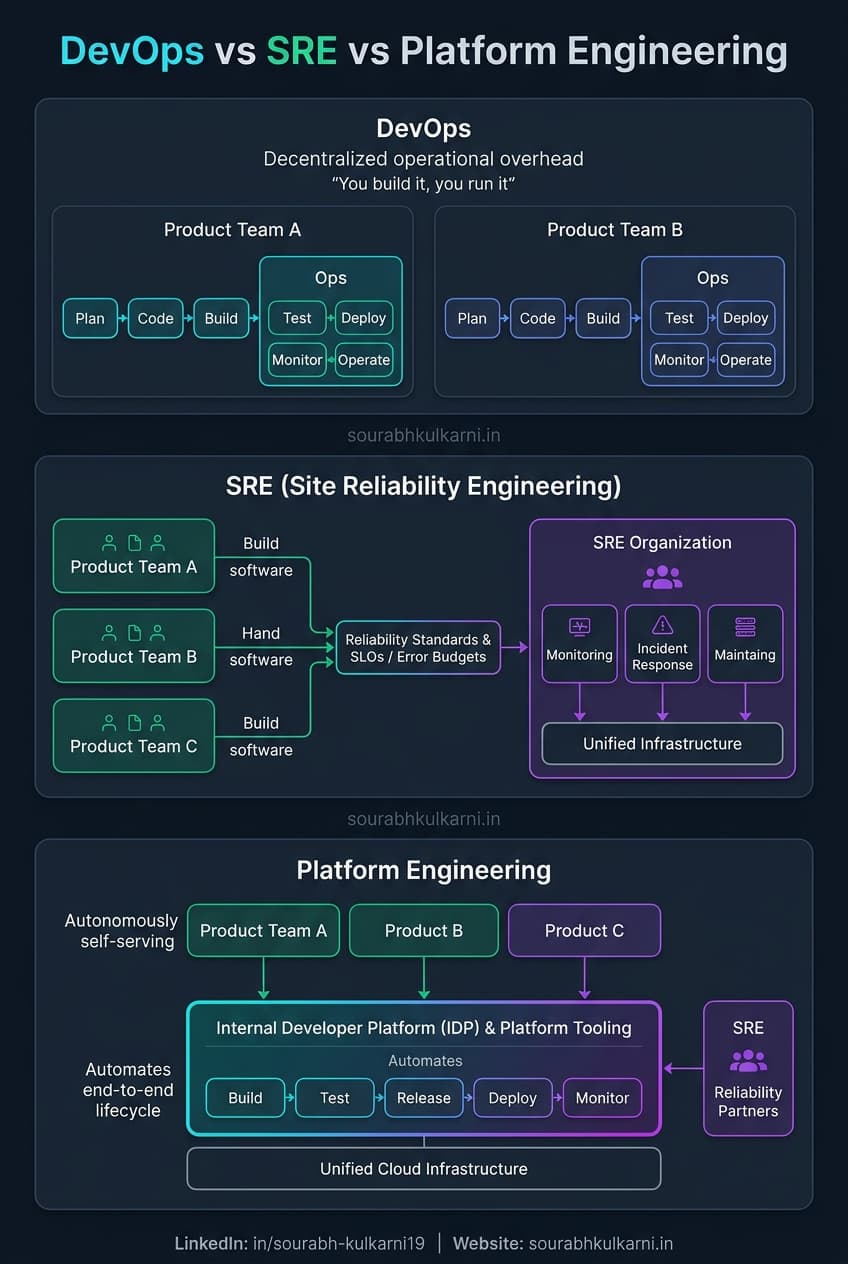
Here is how the flow of work, responsibility, and tooling differs across all three operating models:
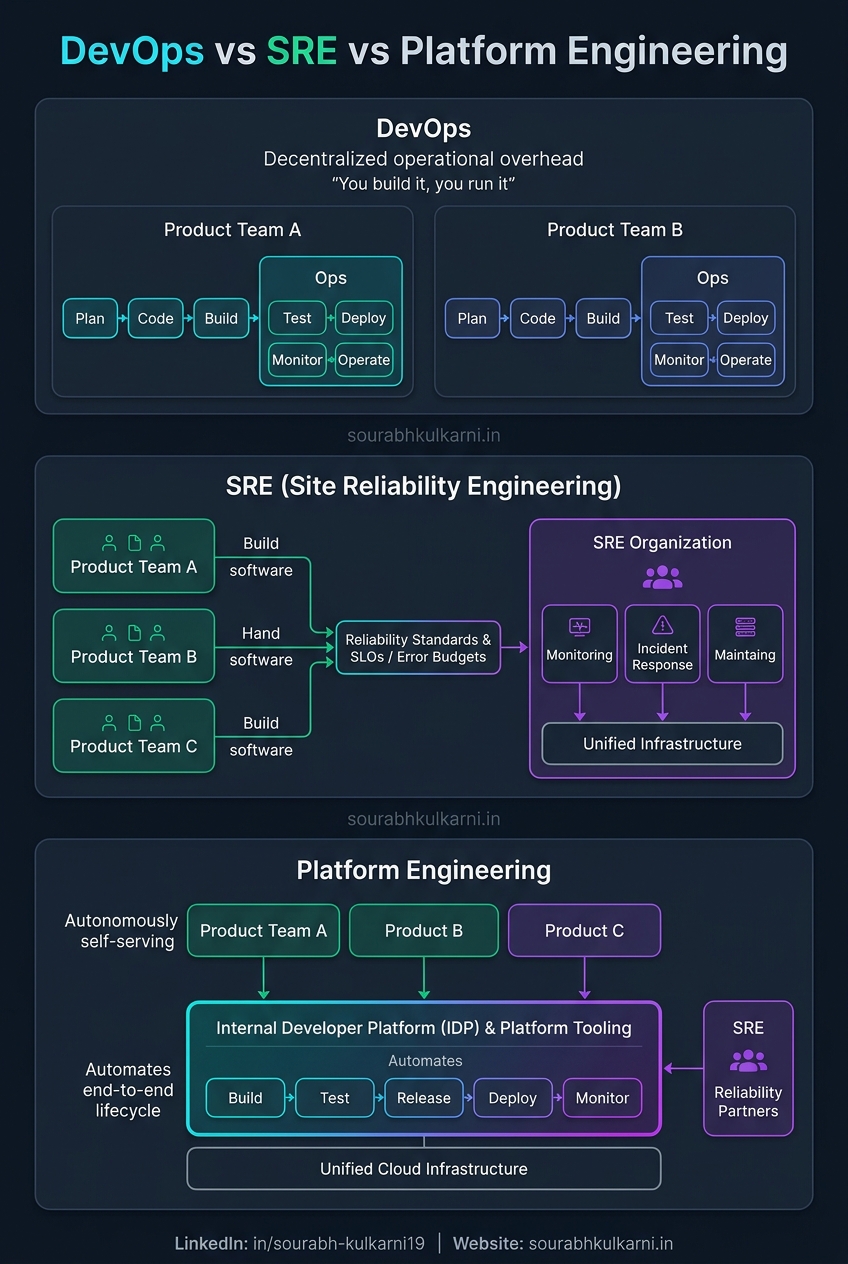 DevOps vs SRE vs Platform Engineering
Breaking Down the Architecture:
- DevOps (Decentralized Operational Overhead):
- Each product team (Product A, Product B) independently handles Plan, Code, Build, and their own siloed Ops (Deploy, Monitor, Operate).
- Result: High flexibility for small teams, but leads to duplication, inconsistent security postures, and severe developer burnout at scale.
- SRE (Contract-Driven Reliability Operations):
- Product teams build applications and hand off operational responsibility through Reliability Standards & SLOs / Error Budgets.
- A dedicated SRE organization manages unified infrastructure, incident response, and telemetry systems.
- Result: High availability and system resilience, but does not inherently simplify day-to-day self-service developer workflows.
- Platform Engineering (Autonomous Self-Service):
- Cross-functional product teams (Product A, B, C) operate with complete autonomy on top of an Internal Developer Platform (IDP).
- The platform automates the end-to-end delivery lifecycle: Build $\rightarrow$ Test $\rightarrow$ Release $\rightarrow$ Deploy $\rightarrow$ Monitor.
- SREs partner with the Platform Team to bake reliability standards, observability baselines, and deployment guardrails directly into the platform tooling itself.
4. The Complete Difference: SRE vs DevOps vs Platform Engineering
To make the distinctions unmistakable, here is a complete, multi-dimensional comparison across every operational facet:
| Dimension | DevOps | Site Reliability Engineering (SRE) | Platform Engineering |
|---|---|---|---|
| Primary Nature | Philosophy & Cultural Mindset | Engineering Implementation of Operations | Product Discipline & Delivery Engine |
| Core Mission | Break down silos between development and operations; ship value faster. | Protect system reliability, availability, and performance under scale. | Reduce cognitive load; provide self-service golden paths for developers. |
| Target Customer | The business and end users (collaborative alignment across teams). | The end user who relies on uptime and service reliability. | The internal software engineer (developers are the platform's customers). |
| Primary Focus | Culture, collaboration, shared responsibility, automation pipelines. | SLIs/SLOs, error budgets, toil reduction, latency, disaster recovery. | Developer experience (DevEx), paved roads, Internal Developer Platforms (IDP). |
| Key Deliverables | CI/CD pipelines, automated testing, collaborative workflows. | Reliability frameworks, automated runbooks, monitoring/alerting, chaos tests. | Service templates, self-service portals (Backstage), CLI tooling, cloud guardrails. |
| North Star Metrics | DORA Metrics: Deployment Frequency, Lead Time for Changes, Change Failure Rate, MTTR. | Reliability Metrics: SLO adherence, Error Budget burn rate, Time to Mitigate, MTBF. | DevEx & Efficiency: Time to first production deploy, developer NPS, pipeline velocity, self-service adoption. |
| Attitude Toward Failure | Shared responsibility: "If it breaks, the team learns and fixes it." | Mathematical & programmatic: Error budgets dictate velocity vs stability. | Guardrails & prevention: Make the safe path the easiest path to prevent misconfigurations. |
| Typical Daily Tasks | Optimizing build pipelines, automating test runs, coaching teams on feedback loops. | Debugging production latency, participating in on-call rotation, conducting blameless postmortems, writing automation code. | Building reusable infrastructure abstractions, user-researching developer bottlenecks, improving golden paths. |
| Common Anti-Pattern | Rebranding a sysadmin team as a "DevOps team" that acts as another ticket queue. | Treating SREs as an outsourced, 24/7 manual operations support desk. | Building an overly rigid portal or complex abstraction that developers bypass. |
5. How They Work Together: The Modern Synergistic Model
These three disciplines are not mutually exclusive competitors. In mature tech organizations, they form a reinforcing triad:
                       ┌─────────────────────────┐
                       │         DevOps          │
                       │    (The Philosophy)     │
                       │ "Culture & Shared Goals"│
                       └────────────┬────────────┘
                                    │
            ┌───────────────────────┴───────────────────────┐
            ▼                                               ▼
┌─────────────────────────┐                       ┌─────────────────────────┐
│           SRE           │                       │  Platform Engineering   │
│   (Reliability Engine)  │◄─────────────────────►│    (Delivery Engine)    │
│ "Guardrails & Outages"  │  Embeds SLOs & Alerts │ "Golden Paths & DevEx"  │
└─────────────────────────┘  into Platform Tools  └─────────────────────────┘
- DevOps defines the Why and the Culture: It sets the shared objective of cross-functional velocity and breaking down organizational barriers.
- SRE defines the Safety Boundaries: It establishes objective reliability targets, error budgets, and incident recovery standards so the system never sacrifices stability for speed.
- Platform Engineering builds the Vehicle: It turns those DevOps practices and SRE guardrails into self-service software products. When a developer creates a new service using a platform template, the SRE's alerting policies, health checks, and Canary deployment pipelines are already baked in by default.
6. Which One Does Your Organization Need?
The right investment depends entirely on your team's size, architecture, and current bottlenecks:
- Early-Stage Startup (1 to 20 Engineers):
- Focus on DevOps culture. Keep teams small, cross-functional, and fully autonomous. Use managed PaaS services (Vercel, Render, AWS ECS) and standard CI/CD. Do not invest in dedicated platform or SRE teams yet.
- Growth Stage (20 to 100 Engineers):
- Introduce SRE practices. As revenue and user scale grow, outages carry real financial and reputational cost. Formalize SLIs/SLOs, create a structured on-call rotation, and embed reliability engineers into high-traffic core services.
- Scale-Up & Enterprise (100+ Engineers across multiple teams):
- Build a Platform Engineering team. Tooling fragmentation, compliance sprawl, and developer cognitive load are now major drags on company velocity. Treat your internal developer platform as a core engineering product with dedicated product managers to pave golden paths.
Summary
- DevOps is how you think and collaborate.
- SRE is how you measure and enforce system reliability.
- Platform Engineering is the platform you build to empower developers to ship safely without getting bogged down by infrastructure toil.
Mastering all three is how modern engineering organizations deliver features with hyperscale velocity while sleeping soundly through the night.