Why Every Cloud Provider Surrendered to Terraform: The Architecture That Defined Modern DevOps
· Sourabh G Kulkarni
Before Terraform, cloud ops was brittle scripts. Here is what Terraform solved, why AWS, Azure, and Google adopted it, and how OpenTofu and Pulumi compete.
Before Terraform, managing cloud infrastructure meant one of two things: clicking through hundreds of browser console screens at 2 a.m., or writing unmaintainable thousands-line bash scripts wrapping the AWS CLI.
Neither approach produced a reliable source of truth. You could not open a pull request against a series of manual mouse clicks in the AWS Management Console. You could not safely diff what a shell script was about to mutate in your production VPC. And when an engineer left the company, whatever undocumented cloud architecture lived inside their head vanished with them.
In 2014, Mitchell Hashimoto and Armon Dadgar at HashiCorp released Terraform to end that chaos.
Today, despite licensing disputes, cloud-native vendor alternatives, and code-based competitors, Terraform (and its open-source fork OpenTofu) remains the undisputed default operating model for enterprise infrastructure. Understanding why requires examining what it fundamentally solved, how cloud providers either competed with it or surrendered and adopted it, and why alternatives still battle for second place.
1. What Terraform Actually Solved: State, Graph, and the Plan
 The Core Terraform Engine Architecture
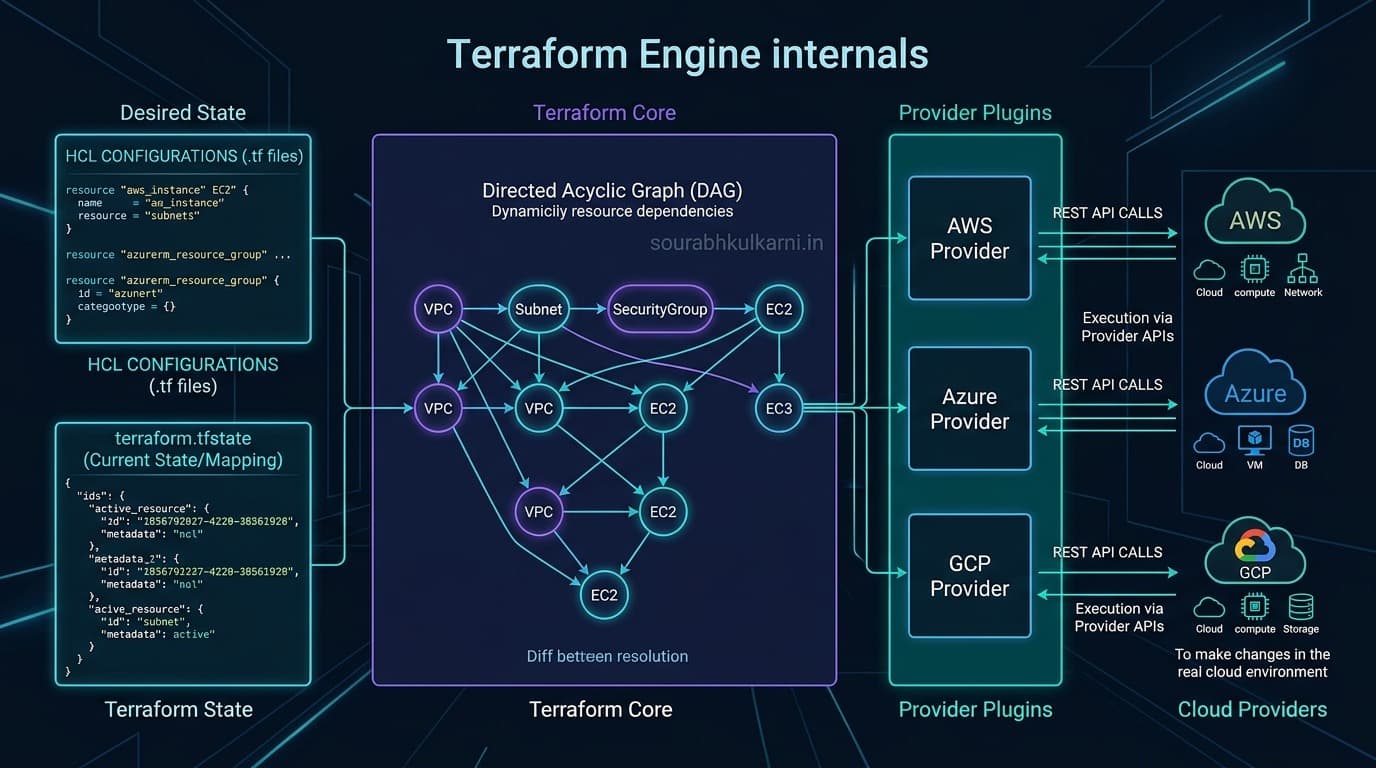
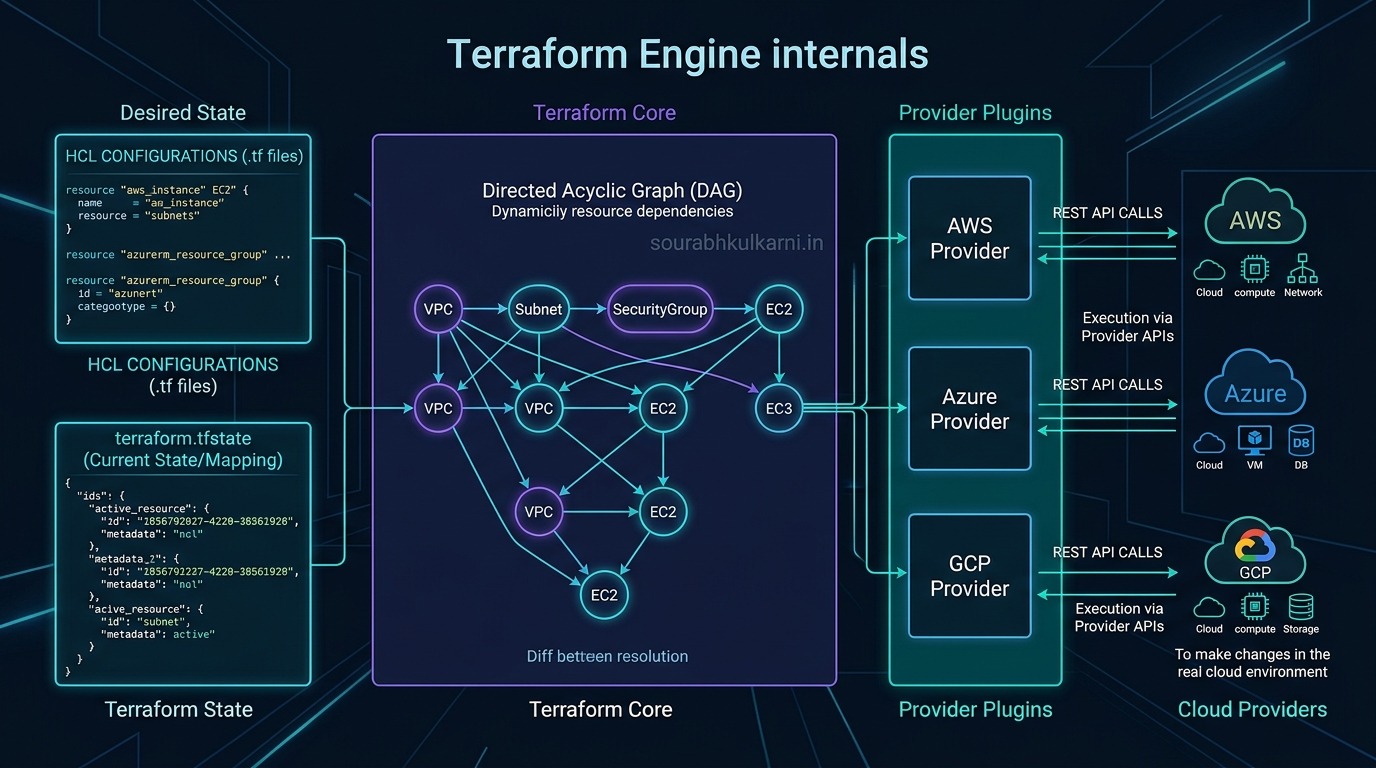
Figure 1: Internal architecture of the Terraform Engine: HCL desired state, state file mapping, DAG resolution, and gRPC provider plugins.
Terraform did not just introduce a new syntax; it pioneered a declarative state-reconciliation architecture for cloud APIs.
┌────────────────────────────────────────────────────────────────────────┐
│                      The Core Terraform Engine                         │
├─────────────────┬─────────────────────────┬────────────────────────────┤
│ Configuration   │ State File              │ Provider Engine            │
│ (.tf files)     │ (terraform.tfstate)     │ (AWS, Azure, GCP APIs)     │
│ Desired State   │ Last Known Reality      │ Calls actual HTTP REST APIs│
└────────┬────────┴────────────┬────────────┴─────────────┬──────────────┘
         │                     │                          │
         ▼                     ▼                          ▼
   [ Directed Acyclic Graph (DAG) ] ──► [ Execution Plan (Diff) ]
   Resolves dependencies in parallel     Shows: (+) Add, (~) Mod, (-) Destroy
1. The Declarative Model vs. Imperative Scripts
In a bash script or Python script using SDKs (like boto3), you write imperative instructions:
- "Check if the security group exists. If not, create it. Then create the subnet. If it fails midway, exit."
- If the script fails on line 42, running it again will crash because the resources created on lines 1–41 already exist.
Terraform is declarative:
- You declare: "I want three subnets and a security group with port 443 open."
- Terraform inspects the real world, determines what is missing or misconfigured, calculates the dependency order, and applies only the diff.
2. The Directed Acyclic Graph (DAG)
How does Terraform know whether to create the VPC before creating the subnet? It parses all references across your .tf files and builds an internal Directed Acyclic Graph (DAG).
If Resource B depends on Resource A (subnet_id = aws_subnet.app.id), Terraform sequences them automatically. If Resource C and Resource D are completely independent, Terraform provisions them concurrently in parallel, shrinking complex cluster deployment times from hours to minutes.
3. The State File: Knowing What It Owns
Cloud APIs are stateless and lack memory of intent. If you have an EC2 instance in AWS, AWS has no idea whether it belongs to a staging experiment or a mission-critical billing pipeline.
Terraform solves this with state (terraform.tfstate). The state file records the exact mapping between your code addresses (aws_instance.web) and the real cloud provider IDs (i-0a1b2c3d4e5f). It tracks metadata, resource dependencies, and schema hashes so the next run knows precisely what Terraform created and owns.
4. The Execution Plan (terraform plan)
This is the single most important engineering innovation of Terraform. Before touching a single live API in production, Terraform generates a deterministic preview diff:
+ create: New resources being created.~ update in-place: Modifying existing attributes without recreation.- / + replace: Destructive recreations (e.g., changing an immutable subnet CIDR or VPC block).
The Golden Rule of IaC: If you run
terraform applywithout carefully reviewing the plan output, you are merely running an imperative script with extra steps.
2. Why It Became the Enterprise Default Choice
Enterprise infrastructure is messy. Companies do not run on a single cloud in a clean greenfield sandbox. They run workloads across AWS, Microsoft Azure, Google Cloud, VMware vSphere on-premises, with DNS managed in Cloudflare, monitoring in Datadog, databases in Snowflake, and authentication in Okta.
Terraform became the default because of one architecture: The Provider Ecosystem.
                           [ Terraform Engine ]
                         (HCL Parser & DAG Graph)
                                    │
    ┌──────────────┬────────────────┼──────────────┬──────────────┐
    ▼              ▼                ▼              ▼              ▼
[AWS Provider] [Azure Provider] [GCP Provider] [Cloudflare]  [Datadog]
    │              │                │              │              │
AWS APIs      Azure APIs       GCP APIs       Cloudflare API Datadog API
- Separation of Core Engine from Providers: HashiCorp decoupled the core CLI from cloud plugins. Anyone—from Amazon and Microsoft down to a weekend open-source developer—can write a provider by translating gRPC calls into cloud REST APIs.
- Unified Engineering Vocabulary: A platform team does not need to train their engineers on four completely different configuration systems. The workflow is identical everywhere:
terraform init # Downloads necessary provider plugins & connects backend terraform validate# Checks schema syntax and types locally terraform plan # Computes API difference against state terraform apply # Executes real API mutations - Immutability & GitOps Alignment: HCL files live in Git. That means infrastructure changes go through standard code reviews, branch protection rules, automated linting, security scans (using tools like
tfsecortrivy), and approval gates.
3. How the Cloud Providers Compete (or Inherited) Terraform
Every major hyperscaler attempted to build a proprietary alternative to keep customers locked inside their ecosystem. Here is how they stack up against Terraform:
1. AWS: CloudFormation & AWS CDK
- The Approach: AWS introduced CloudFormation (CFN) in 2011 using verbose JSON, later adding YAML. In 2019, AWS released the AWS Cloud Development Kit (CDK), allowing developers to define infrastructure in TypeScript or Python, which compiles down into CloudFormation templates.
- The Competition: CloudFormation is deeply integrated into AWS and offers native day-0 support for every new AWS feature.
- The Enterprise Reality: CFN is notoriously slow. A failed stack update can get stuck in
ROLLBACK_IN_PROGRESSfor 45 minutes without clear error messages. Drift detection is notoriously weak. Most importantly, it is 100% proprietary to AWS. A multi-cloud enterprise cannot configure its Cloudflare DNS or Datadog alerts using CloudFormation.
2. Azure: ARM Templates & Azure Bicep
- The Approach: Microsoft originally used Azure Resource Manager (ARM) JSON templates—an unreadable nightmare of nested brackets and escaped strings. In response to Terraform's dominance, Microsoft built Azure Bicep, a clean domain-specific language designed specifically for Azure.
- The Competition: Bicep is elegant, compiles directly to ARM, and supports day-0 Azure API updates without waiting for provider releases.
- The Enterprise Reality: Like CloudFormation, Bicep is Azure-only. Enterprises adopting Bicep still need a second tool for their AWS accounts, SaaS providers, and Kubernetes clusters.
3. Google Cloud: Deployment Manager & Config Connector
- The Approach: Google built Deployment Manager, but it was cumbersome and unpopular. Instead of pouring resources into a losing battle, Google made a strategic shift: Google Cloud officially adopted Terraform as its primary infrastructure language.
- The Competition: Google maintains and publishes official, production-ready Cloud Foundation Fabric Terraform modules as their gold standard. Google also introduced Config Connector, which lets teams manage Google Cloud resources via Kubernetes CRDs (Kubernetes Resource Model).
4. Oracle Cloud (OCI): Resource Manager
- The Ultimate Surrender: Oracle didn't even bother inventing a proprietary DSL or templating engine. Oracle Cloud literally built OCI Resource Manager directly on top of Terraform.
- In Oracle Cloud, your native infrastructure provisioning engine is a fully managed Terraform backend as a service, running standard HCL configurations natively inside OCI.
4. The Alternatives: Why They Remain in Second Place
While Terraform dominates enterprise market share, several capable alternatives exist. Each has strengths, but each carries trade-offs that keep it in second place for large enterprises:
┌─────────────────┬──────────────────────────────────┬───────────────────┐
│ Tool            │ Core Paradigm                    │ Why It's in #2    │
├─────────────────┼──────────────────────────────────┼───────────────────┤
│ **Pulumi**      │ General-purpose languages        │ Imperative risk;  │
│                 │ (TypeScript, Python, Go, C#)     │ hard to audit AST │
├─────────────────┼──────────────────────────────────┼───────────────────┤
│ **OpenTofu**    │ Open-source fork of Terraform    │ Enterprise lag;   │
│                 │ (Linux Foundation, MPLv2)        │ corporate inertia │
├─────────────────┼──────────────────────────────────┼───────────────────┤
│ **Ansible**     │ Procedural Config Management     │ No true state diff│
│                 │ (YAML plays over SSH / APIs)     │ Weak for cloud IaC│
├─────────────────┼──────────────────────────────────┼───────────────────┤
│ **Crossplane**  │ Kubernetes Resource Model (KRM)  │ Requires K8s      │
│                 │ (Continuous reconciliation CRDs) │ cluster overhead  │
└─────────────────┴──────────────────────────────────┴───────────────────┘
1. Pulumi: The "Real Code" Promise
- The Pitch: Why learn HCL when you can write real TypeScript, Python, or Go? You get native loops, classes, autocompletion, type-checking, and standard unit-testing frameworks (
npm test,pytest). - Why It's in 2nd Place:
- The Danger of Imperative Logic: General-purpose code allows side effects. An engineer can write an API call inside a loop that queries an external database or generates random UUIDs on every run. This breaks the fundamental requirement of deterministic execution plans.
- Security & Governance: Security auditors can easily read and parse declarative HCL ASTs using static policy tools like Open Policy Agent (OPA) or Checkov. Auditing arbitrary, Turing-complete Python code for compliance violations is significantly harder.
- Staffing: DevOps and SRE teams are not all full-stack software engineers. HCL provides a safe, bounded DSL with guardrails.
2. OpenTofu: The Linux Foundation Fork
- The Pitch: In August 2023, HashiCorp shifted Terraform's license from open-source MPLv2 to the restrictive Business Source License (BSL/BUSL). In response, the community—backed by Gruntwork, Spacelift, env0, and the Linux Foundation—forked Terraform into OpenTofu.
- Why It's in 2nd Place: OpenTofu is technically excellent, fully backward-compatible, and introduces great features (like state encryption and early variable evaluation). However, large Fortune 500 enterprises move slowly. Many have existing commercial contracts with HashiCorp (now part of IBM) for Terraform Enterprise. While OpenTofu is winning community hearts and new startups, legacy enterprise migration takes years.
3. Ansible: Configuration vs. Provisioning
- The Pitch: Ansible is agentless, written in simple YAML, and connects over SSH.
- Why It's in 2nd Place for Cloud: Ansible is a configuration management tool, not an infrastructure provisioning engine. It lacks an immutable state file and a real dependency graph for cloud resources. Running an Ansible playbook against 500 cloud resources to verify drift requires hundreds of sequential API calls. The industry consensus is clear: Use Terraform to provision the VM and VPC; use Ansible to configure the packages inside the operating system.
5. Enterprise Production Blueprint: How I Structure Terraform
To prevent the notorious "monolithic state blast radius" disaster, never put your entire cloud into a single .tf directory.
Here is the production-proven layout separating environments, credentials, and state backends:
terraform-infrastructure/
├── modules/
│   ├── networking/      # Reusable VPC, Subnets, Gateways
│   ├── kubernetes/      # EKS / GKE cluster definitions
│   └── database/        # RDS / Cloud SQL configurations
└── environments/
    ├── dev/
    │   ├── main.tf      # Calls modules with dev variables
    │   ├── backend.tf   # Remote S3 bucket + DynamoDB lock (Dev account)
    │   └── terraform.tfvars
    ├── uat/
    │   ├── main.tf
    │   ├── backend.tf   # Isolated UAT account backend
    │   └── terraform.tfvars
    └── prod/
        ├── main.tf
        ├── backend.tf   # Dedicated Production state with KMS encryption
        └── terraform.tfvars
Why This Architecture Wins:
- Isolated Blast Radius: A mistake or failed state lock in
devcannot physically touchprod. The backend storage and cloud credentials are completely isolated. - Deterministic CI/CD Promotion: Code advances across Git branches (
main$\rightarrow$staging$\rightarrow$production). An automated pipeline runsterraform plan -out=tfplanon merge, and executesterraform apply tfplanonly after passing manual peer-review approval gates. For a complete guide on structuring this, see Terraform across Dev, UAT, and Production.
The Engineering Conclusion
Terraform did not become the industry default because HCL is the world's most expressive language. It won because it solved the core operational dilemma of cloud computing:
- It turned ephemeral, click-driven cloud infrastructure into reviewable, version-controlled text.
- It decoupled the orchestration engine from specific cloud APIs through a universally adopted provider model.
- It introduced the execution plan, giving engineering teams confidence that what they are about to apply matches their declared intent.
Cloud providers will continue to offer proprietary shortcuts, and newer tools will iterate on programming language support. But for multi-cloud enterprises that prioritize auditability, deterministic previews, and battle-tested reliability, Terraform remains the bedrock of cloud infrastructure.