Betting Trillions on 2-Space Indentation: The Unlikely Triumph and Hidden Traps of YAML
· Sourabh G Kulkarni
From a 2001 alternative to XML to the universal language of Kubernetes, Docker, and CI/CD pipelines. Here is how YAML won, the infamous Norway problem, and why it remains impossible to displace.
If you work in cloud infrastructure, platform engineering, or software delivery, you spend an astonishing amount of your career typing spaces into a text editor.
Kubernetes manifests, Docker Compose definitions, GitHub Actions workflows, GitLab CI pipelines, Ansible playbooks, Helm chart values, Prometheus alert rules, and OpenAPI specifications all share one universal format: YAML.
How did an obscure format designed in 2001 beat out XML and JSON to become the undisputed configuration standard of the cloud? And why does a technology that powers trillions of dollars in cloud infrastructure still trip up engineers with boolean coercion, indentation bugs, and the infamous "Norway Problem"?
To understand YAML is to understand the history of configuration languages—and why the industry is stuck with it for the foreseeable future.
1. Where YAML Came From: Escaping the XML Angle-Bracket Hell
In the late 1990s and early 2000s, XML (Extensible Markup Language) ruled enterprise software. Everything from Ant build scripts and Java application servers to SOAP web services was configured in XML:
<!-- The XML Era: Verbose, repetitive, and noisy to diff in Git -->
<server>
    <host>api.internal.network</host>
    <port>8080</port>
    <environments>
        <environment>staging</environment>
        <environment>production</environment>
    </environments>
    <tls enabled="true">
        <certPath>/etc/ssl/cert.pem</certPath>
    </tls>
</server>
XML was machine-readable, but typing it by hand was agonizing. Closing tags bloated file sizes, visual noise overwhelmed human eyes, and Git diffs were cluttered with bracket formatting.
In May 2001, Clark Evans, alongside Ingy döt Net and Oren Ben-Kiki, set out to design a human-friendly alternative.
The project originally stood for "Yet Another Markup Language." However, the creators quickly realized that markup languages (like HTML or XML) were designed to wrap formatting around text documents. YAML was designed to serialize raw structured data (objects, arrays, strings, and scalars). They rebranded it with a classic hacker recursive acronym:
YAML: YAML Ain't Markup Language
# The YAML equivalent: Clean, outline-style readability
server:
  host: api.internal.network
  port: 8080
  environments:
    - staging
    - production
  tls:
    enabled: true
    certPath: /etc/ssl/cert.pem
2. Why YAML Beat XML and JSON for Configuration
When JavaScript took over the web, JSON (JavaScript Object Notation) displaced XML for machine-to-machine APIs. But while JSON is phenomenal for web browsers sending payloads to backend servers, it is a terrible format for human-edited configuration files.
┌────────────────────────────────────────────────────────────────────────┐
│                   XML vs. JSON vs. YAML Comparison                     │
├───────────────┬────────────────────────────┬───────────────────────────┤
│ Format        │ Strengths                  │ Critical Flaw for Config  │
├───────────────┼────────────────────────────┼───────────────────────────┤
│ **XML**       │ Strict schema validation   │ Verbose angle-bracket hell│
│ **JSON**      │ Native to web/browsers     │ No comments; strict syntax│
│ **YAML**      │ Human-readable; comments   │ Whitespace & type gotchas │
└───────────────┴────────────────────────────┴───────────────────────────┘
YAML won the configuration wars because it solved the three fundamental flaws of JSON for operators:
- Native Inline Comments (
#): Configuration files require documentation. Why was this timeout set to 45 seconds? Who approved this feature flag? In standard JSON, comments are strictly forbidden by specification. In YAML, operators can document intent directly inline. - No Trailing Comma Syntax Errors: How many times has a developer added a new property to a JSON file and broken production because they left a trailing comma or forgot a comma on the preceding line? YAML uses clean indentation and line breaks, completely eliminating punctuation errors.
- Clean Multi-Line Strings: Try embedding a 50-line bash script, private SSL certificate, or SQL query inside a JSON string. You must manually escape every newline (
\n), quote, and backslash. In YAML, operators use the block scalar operators (|for literal newlines,>for folded text), keeping complex scripts readable.
3. How YAML Became the Undisputed Cloud Standard
 How YAML Powers Cloud Architecture
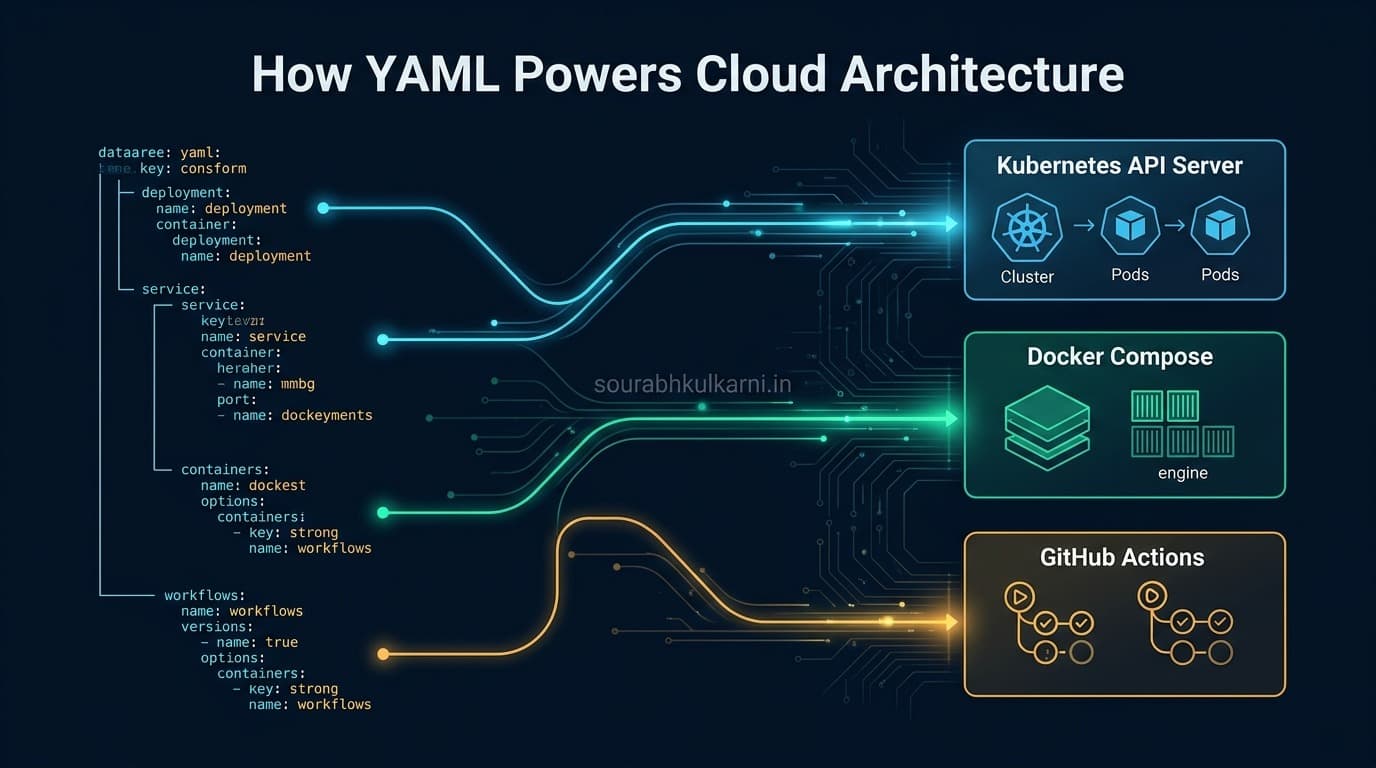
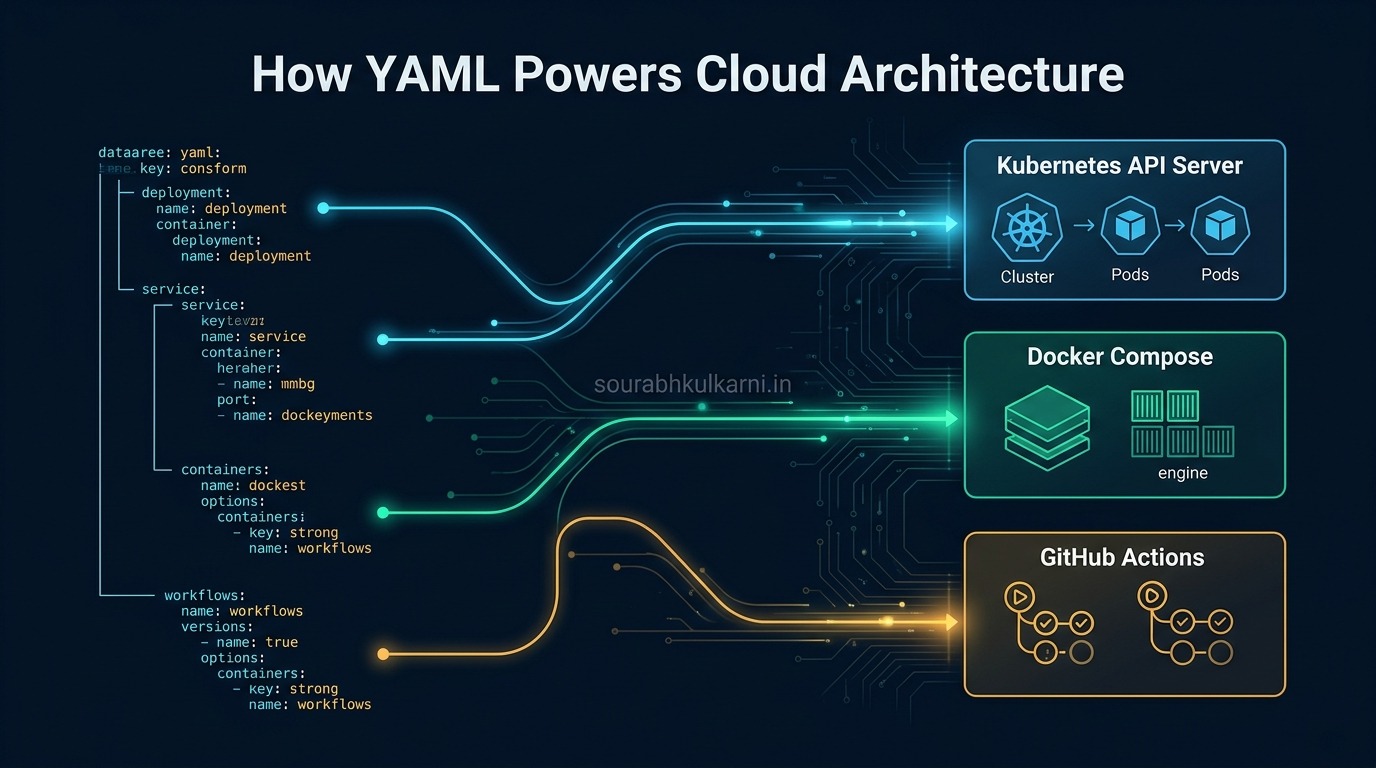
Figure 1: Declarative YAML configuration trees feeding into Kubernetes API Server, Docker Compose, and CI/CD automation runners.
For its first decade, YAML was a modest, niche format favored by the Ruby on Rails community. Its ascent to global dominance began between 2012 and 2015, driven by five consecutive architectural adoptions:
2012: Ansible ──► 2013: Docker Compose ──► 2014: Kubernetes ──► 2018: GitHub Actions
(Playbooks)       (Multi-Container)        (Universal API)       (CI/CD Workflows)
- Ansible (2012): Michael DeHaan chose YAML for Ansible playbooks so system administrators wouldn't need to learn a programming language like Ruby (Puppet/Chef) just to install a package.
- Docker Compose (2013): As developers ran multiple containers locally, Docker needed a single file to define networks, volumes, and ports.
docker-compose.ymlbecame a worldwide standard. - Kubernetes (2014–2015): The watershed moment. When Google open-sourced Kubernetes, they needed an interface that mapped directly to REST API JSON objects, but was easily authored and reviewed by humans in Git. Every Kubernetes object—from Pods and Deployments to Custom Resource Definitions (CRDs)—is applied as YAML.
- CI/CD Pipelines (2015–Present): GitLab CI introduced
.gitlab-ci.yml, and GitHub Actions standardized on.github/workflows/*.yml. The era of clicking through Jenkins web UI forms was officially replaced by version-controlled YAML pipelines.
Once cloud platforms and container schedulers standardized on YAML as the declarative representation of desired state, YAML stopped being a format preference and became the operating interface of cloud computing.
4. The Dark Side: Why Developers Love to Hate YAML
Despite its dominance, YAML is notoriously full of edge cases that have caused severe production outages.
1. The Infamous "Norway Problem"
In YAML 1.1, the parser evaluates unquoted words like true, false, yes, no, on, and off as booleans.
Consider a list of international country codes:
countries:
  - US  # Parsed as String "US"
  - GB  # Parsed as String "GB"
  - DE  # Parsed as String "DE"
  - NO  # Parsed as Boolean FALSE!
Because NO was parsed as false, application databases across the globe had their country records corrupted for Norway. While YAML 1.2 fixed this specification, millions of deployed parsers still run legacy YAML 1.1 engines.
2. The Octal Number and Float Trap
YAML attempts to automatically guess data types. If an integer has a leading zero, legacy parsers treat it as octal:
server:
  port: 0808    # Parse Error! (0808 is an invalid octal number)
  version: 1.10 # Parsed as Float 1.1 (the trailing zero is dropped!)
If your software checks if version == "1.10", your check fails silently because YAML parsed it as the floating-point number 1.1.
3. Tabs vs. Spaces
YAML forbids literal tab characters (\t) for indentation. A single rogue tab inserted by an IDE will trigger a fatal parser exception (yaml.scanner.ScannerError: while scanning for the next token found character '\t' that cannot start any token).
4. Anchors, Aliases, and Security Exploits
YAML supports DRY duplication via anchors (&) and aliases (*):
defaults: &base_config
  timeout: 30
  retries: 3

api_service:
  <<: *base_config
  port: 8080
While convenient, this enables the "Billion Laughs" Denial of Service attack (Entity Expansion). An attacker can submit a 1KB YAML payload with recursively nested aliases that expands into gigabytes of memory upon parsing, crashing web servers instantly.
Furthermore, legacy parsers (such as Python's yaml.load() or Ruby's Psych) allowed YAML to serialize and deserialize arbitrary programmatic objects, leading to remote code execution (RCE) vulnerabilities until libraries enforced yaml.safe_load().
5. Can Modern Alternatives Displace YAML?
Several alternative formats have emerged to challenge YAML:
┌──────────────────┬──────────────────────────┬──────────────────────────┐
│ Alternative      │ Core Strength            │ Why It Won't Replace YAML│
├──────────────────┼──────────────────────────┼──────────────────────────┤
│ **TOML**         │ Predictable, flat schema │ Clumsy for deep hierarchy│
│ **CUE**          │ Built-in type constraints│ Steep learning curve     │
│ **Jsonnet**      │ Programmable JSON        │ Turing-complete complexity│
│ **KCL**          │ Cloud-native OOP schema  │ Ecosystem inertia        │
└──────────────────┴──────────────────────────┴──────────────────────────┘
- TOML (Tom's Obvious Minimal Language): Adopted by Rust (
Cargo.toml) and Python (pyproject.toml). TOML is unambiguous and clean for flat configuration. But for deeply nested hierarchies (like a Kubernetes Deployment with Pod specs, container probes, affinity rules, and volume mounts), TOML's bracket syntax[server.network.ingress.tls]becomes completely unreadable. - CUE & KCL: Modern configuration languages designed by ex-Google Borg engineers. They provide strict schemas, compile-time validation, and inheritance. They are technically superior, but require rewriting millions of lines of existing Helm charts and CI/CD pipelines.
6. Production Best Practices for Bulletproof YAML
To survive in a cloud-native world without falling victim to YAML landmines, follow these battle-tested engineering rules:
- Quote All Strings Explicitly: Whenever a value contains versions, country codes, or potential booleans, wrap them in double quotes:
# Safe, unambiguous typing country: "NO" version: "1.10" port: "8080" - Enforce
yamllintin CI: Run an automated linter on every commit to reject tabs, enforce two-space indentation, and detect duplicate keys:yamllint -d "{extends: default, rules: {line-length: {max: 120}}}" . - Always Use Safe Parsers: If you parse YAML in backend applications, never use generic deserialization functions. In Python, use
yaml.safe_load(); in Go, use standardsigs.k8s.io/yamlorgopkg.in/yaml.v3.
The Engineering Conclusion
YAML is imperfect. Its whitespace sensitivity can be infuriating, and its type coercion rules are a historical quirk of early 2000s design.
Yet, despite all criticism, YAML won because it solved the human problem of configuration:
- It made desired state readable at a glance without bracket noise.
- It allowed operators to comment their reasoning directly alongside their infrastructure.
- It became the common protocol spoken by Kubernetes, cloud providers, and automated deployment pipelines worldwide.
We may love to complain about YAML, but as long as software delivery is driven by GitOps, declarative APIs, and human code review, YAML is here to stay.